Task

Why the team doesn't complete tasks on time and how this changes Keruj
In many companies, the problem of overdue tasks looks the same. The manager sets a task, the employee agrees, a few days pass, and it turns out that the work is either not done, partially completed, or lost entirely among messages, calls, and spreadsheets. This delays projects, loses clients, causes conflicts between departments, and leaves the manager forced to constantly control the team manually.
Usually, the reason is not that employees do not want to work or are uninterested in the result. Most often, the problem lies in the lack of a system. When a team works through messengers, verbal agreements, notes, or chaotic spreadsheets, tasks quickly lose their structure. Some of the information remains in personal chats, some in employees' memories, and some is not recorded at all.
In such a model, the manager is constantly forced to remind, check, clarify statuses, and look for those responsible. The team spends a lot of time not on doing the work, but on trying to understand exactly what needs to be done, within what timeframe, and who is responsible for it.
That is why systematically working with tasks today is not an extra advantage, but a necessity for the stable operation of a company.
In Keruj, tasks become part of a single workflow. They do not exist separately from projects, clients, documents, or communication. All information is stored in the service, accessible to responsible employees, and interconnected. This allows the team to work much more organized and reduces the number of situations where work gets lost.

One of the most common reasons for untimely completion is unclear task formulation
Often, an employee receives a brief message like "prepare documents" or "contact the client", but without details, deadlines, or additional materials. As a result, the employee is forced to clarify information, spend time searching for files, or guess on their own what exactly the manager meant.
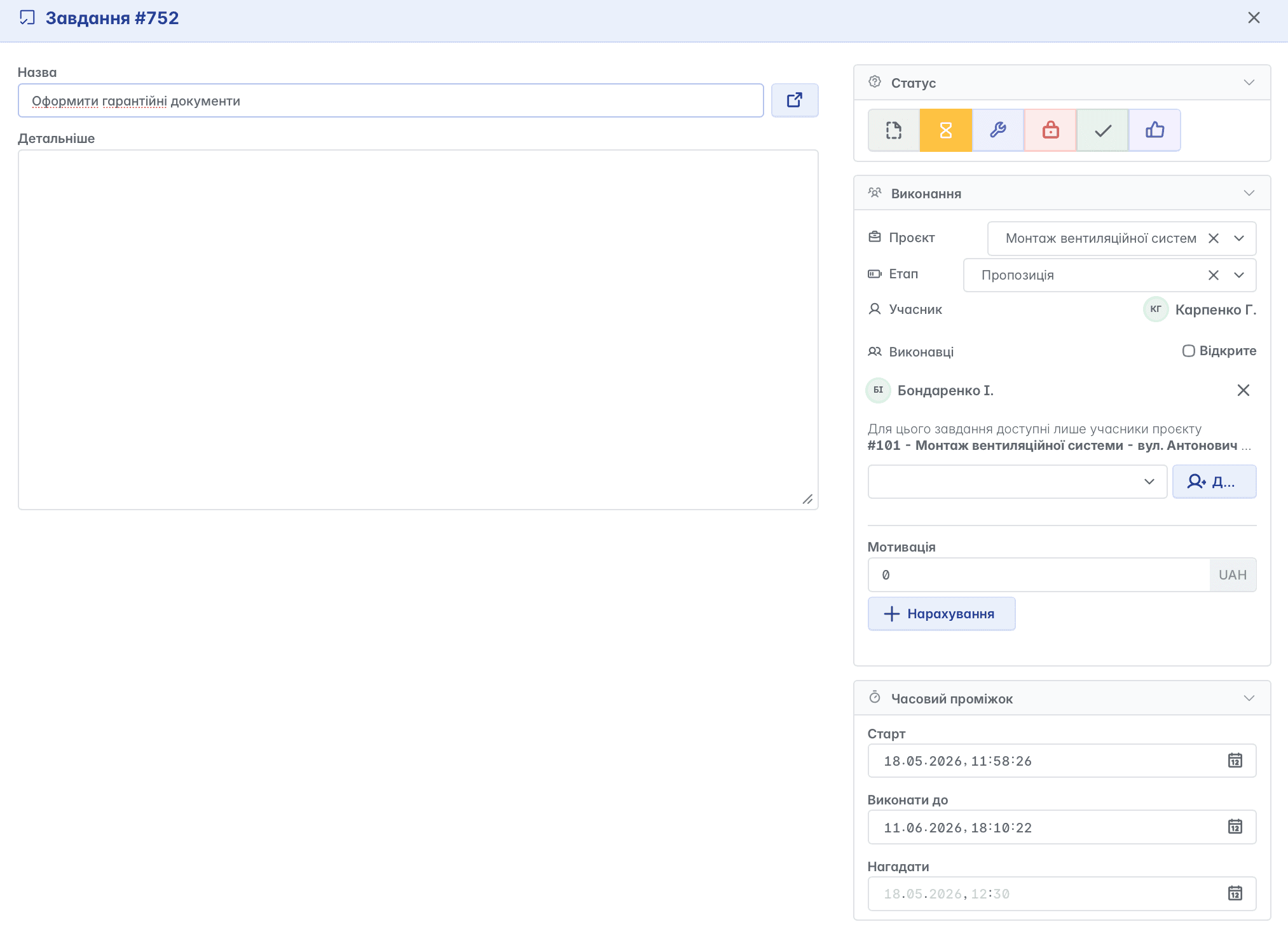
In Keruj, a task contains all the necessary information for work. You can add a description, deadline, assignee, and comments to it, and associate it with a project, contractor, or documents. The employee does not need to look for information in different places—everything is gathered in a single workspace.
Another problem in most companies is the lack of transparency
When a manager does not see the actual status of task completion, management begins to build on constant clarifications. Endless messages like "what status?", "when will it be ready?", and "why isn't it done yet?" appear. This creates an unnecessary burden both for the manager and for the team.
Keruj allows you to see the current status of work without extra calls or chats. At any moment, the manager can view which tasks are ongoing, which are overdue, who is overloaded with work, and where there is free resource. This helps make decisions faster and react to problems even before they start affecting the business.
The issue of responsibility deserves a separate mention
In many companies, tasks are assigned to "everyone." As a result, no one understands who exactly has to bring the work to a result. Such situations arise particularly often in teamwork, where several employees or departments are involved simultaneously.
In Keruj, each task has a specific assignee. The system records changes, comments, statuses, and work history. This allows avoiding misunderstandings and shapes a clear area of responsibility for each employee.
Overloading the team is also often a reason for delays
Without systemic control, it is difficult for a manager to assess the actual workload of employees. Some employees get too many tasks and start missing deadlines, while others may have a much lighter workload.
When all processes are managed in Keruj, the team's workload becomes visible. The manager sees the number of active tasks, their complexity, priority, and can distribute work among employees more evenly. This has a positive impact not only on the speed of completion but also on the quality of the team's work in general.

Communication also plays an important role
In many companies, task discussions take place in various messengers, personal chats, or phone calls. Part of the agreements gets lost, new participants in the process do not see previous discussions, and the manager does not have a complete picture of the situation.
In Keruj, communication is conducted directly inside the workflow. Comments, clarifications, and modifications remain in the task card and are accessible to all participants in the work. This significantly reduces the number of errors and allows faster decision-making.

Another major reason for untimely completion is the lack of priorities
When an employee simultaneously receives dozens of tasks from different channels, it is difficult to understand what needs to be done first. Because of this, the team often deals with urgent but not the most important matters.
Systemic work in Keruj helps structure processes. Tasks have statuses, deadlines, and priorities, and employees see their own list of work in a clear format. This helps better plan the workday and concentrate on important processes.

When a company transitions from chaotic management to systemic work, not only the speed of task completion changes. The work culture of the team changes. People spend less time searching for information, less frequently forget about agreements, understand their responsibilities better, and work much more calmly.
For the manager, this means less manual control and more predictability. For employees, it means clear processes and a more comfortable work environment. For the business, it means fewer losses, faster processes, and higher quality of service for clients.
Keruj does not just help set tasks. The service creates a single space for managing the company's work, where all processes are interconnected, transparent, and controlled. This is exactly what allows the team to work in an organized manner, complete tasks on time, and achieve results without constant chaos and overload.


