Finance

Financial discipline of the team through data transparency
Financial discipline is not just about the numbers in reports. It is about the daily actions of the team: how tasks are created, how resources are spent, how costs are recorded, and how decisions are made.
In many companies, financial control boils down to checking results at the end of the month. But at that point, it is already difficult to influence the situation.
Instead, data transparency allows for financial management in the course of work. And this is exactly what changes team behavior.
What financial discipline is in practice
Financial discipline is when every action in the company has a clear impact on the result.
This means that:
expenses do not arise "just because", tasks are completed within budget, and decisions are made based on current data rather than assumptions.
This is not about strict control or restrictions. It is about awareness and predictability.
When a team understands how its actions affect the financial result, the approach to work changes: unnecessary costs are reduced, resources are better planned, and responsibility increases.
Why discipline does not work without transparency
If financial information is closed or scattered, the team is working "blindly".
Employees do not see the project budget, do not understand constraints, and do not know how their actions affect profit. As a result, typical situations arise: material overruns, delayed tasks, and uncoordinated decisions.
The manager in such a situation is forced to constantly control the process manually. This creates micro-management but does not yield stable results.
Without transparency, financial discipline relies on individual people rather than on a system.
How Keruj protects data transparency
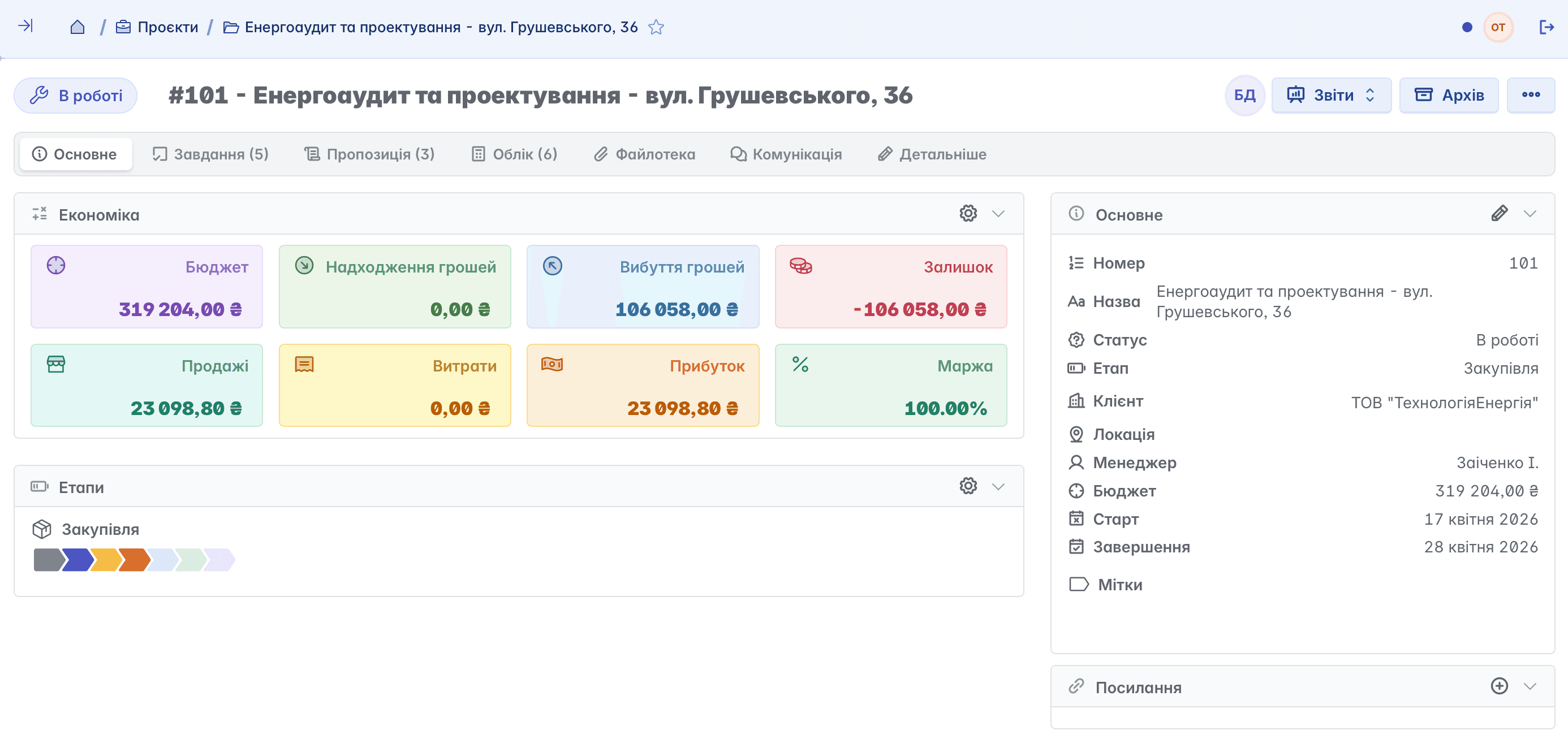
In Keruj, financial information is not formed separately but as part of daily work.
Each project has its own budget. In proposals, the cost of work and materials is recorded. In tasks, the scope of work and responsible persons. In financial and warehouse documents, actual expenses.
Crucially, this data is interconnected. This allows for seeing the complete picture without additional summaries and manual calculations.
Transparency means that access to information is granted not only to managers but also to the team — within their roles. This creates a single information field where everyone works with the same data.
How team behavior changes
When data becomes transparent, not only control but also the approach to work changes.
Employees start to plan their actions better because they see constraints and understand the consequences. Decisions become more reasoned, and costs more controlled.
Instead of a situation where overruns are discovered post-factum, the team sees them in the process and can react immediately.
This builds responsibility without extra pressure.
Real-time cost control
One of the key benefits of transparency is the ability to control costs during the execution of work, rather than after it is finished.
In Keruj, actual expenses are generated automatically: when materials are written off, financial documents are created, or completed works are recorded.
This allows comparing planned and actual figures at any time to see if the team is staying within budget.
If deviations occur, they can be quickly found and understood — without long analysis and manual searching for data.
Less micromanagement — more control
Paradoxically, transparency reduces the need for manual control.
When a manager sees actual data in the service, they do not need to constantly check the status of tasks or verify costs manually.
The team also does not need constant reminders because the system itself establishes clear boundaries: budgets, deadlines, and scopes of work.
As a result, control becomes systemic rather than personal.
A single source of truth for finances
Another important advantage is that all financial data is gathered in one place.
There is no longer a need to reconcile information from different spreadsheets or double-check data with other departments. Everyone works with a single, up-to-date source of information.
This reduces errors, speeds up decision-making, and makes the financial picture clear to the entire team.
What transparency brings to business
Data transparency impacts not only control but also company results.
It allows to:
reduce cost overruns and loss of resources
increase team responsibility
react faster to deviations
make decisions based on actual data
All this builds stable financial discipline without constant manual control.
Financial discipline does not appear on its own. It is built through transparent processes and clear data.
Keruj helps make finances a part of daily work: expenses are recorded automatically, budgets are visible in real-time, and deviations can be controlled immediately.
As a result, the team works more mindfully and the business achieves not only control but also a predictable financial outcome.


