Task

Transparency of responsibility: who is responsible for what
In many companies, processes look organized only at first glance. Tasks are created, the team works, projects move forward — but it is worth asking a simple question: who is responsible for the result? And at that moment, uncertainty arises.
Someone thought it was a colleague's area of responsibility, someone did not get a clear task, and someone simply dropped out of the process. In the end, the business faces not so much a lack of resources as a lack of clarity.
This is exactly the problem that Keruj solves — by building a transparent system of accountability.
Why responsibility is often blurred
In most teams, responsibility is formed not systematically, but situationally. Tasks are assigned verbally, in messengers, or in correspondence, and over time, the understanding of who exactly is supposed to bring the matter to a result is lost.
Even if the team is experienced, typical situations arise without a single system:
tasks are performed partially or with delays
it is difficult to determine the cause of an error
the manager is forced to constantly clarify statuses
responsibility is "smeared" among several people
This creates an unnecessary burden on all participants in the process and slows down the work of the company as a whole.
What Keruj changes
Keruj builds the logic of work around clear accountability. In the service, every action has its owner — and this is embedded at the level of the structure itself.
When a task is created, it immediately gets an assignee. This is not a formality, but the basis of the process: this exact person is responsible for the result, regardless of how many other participants are involved.
If several people participate in a task, the roles do not get mixed up. There is one assignee, and others join as co-performers or discussion participants. This approach allows keeping focus and avoiding situations where a task hangs between several people.
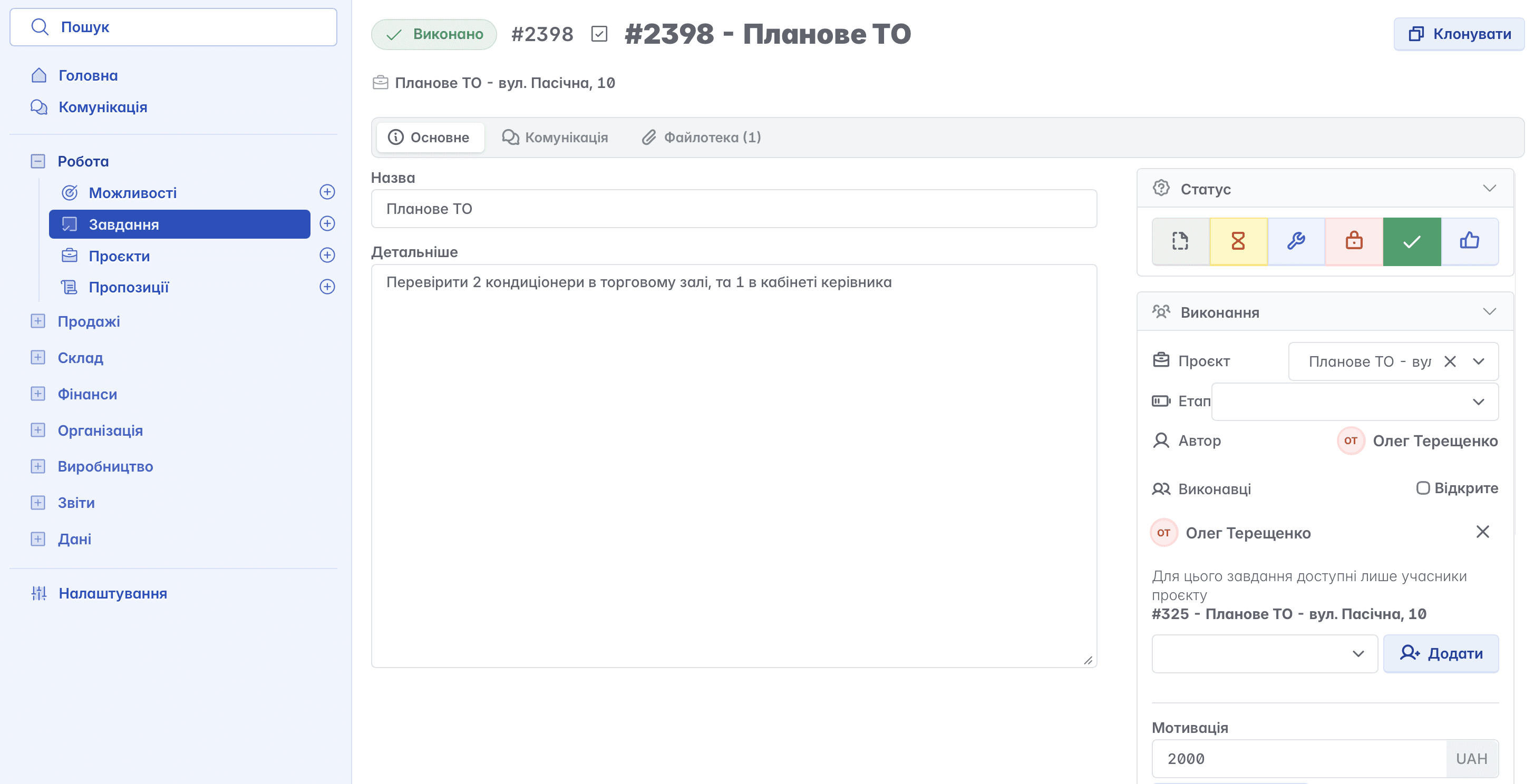
Accountability at the process level
Importantly, transparency in Keruj is not limited only to tasks. It runs through all key processes of the company.
In projects and opportunities, there is always a person responsible for their implementation. In working with documents, it is clearly visible who created it, who is its performer, and at what stage it is.
Thanks to this, any process can be quickly "read": to understand who is leading it, where it is now, and what needs to be done next.
A single point of truth
One of the key advantages of the service is that all tasks, agreements, and changes are recorded in one place. This means that responsibility no longer lives in the minds of employees or in chats.
The team works in a single environment where each task has its context: description, deadline, assignee, and change history. At any time, you can return to the task and understand what is happening without additional clarifications.
This approach significantly reduces the amount of communication for clarification and frees up time for actual work.
What this gives the manager
For a manager, transparent accountability means predictability. Instead of constant control, an understanding emerges of how processes are moving and where attention is needed.
Keruj allows you to quickly see which tasks are completed on time, where delays occur, and who is responsible for this. This makes it possible to make decisions based on the real picture, rather than subjective feelings.
At the same time, the manager stops being a mediator in all matters. The team gets more autonomy, but at the same time works within clear boundaries.
What this gives the team
For the team, transparency of accountability is, above all, clarity. Everyone knows their role, their tasks, and the expected result.
The need to constantly clarify who is doing what disappears. Less stress due to uncertainty, fewer conflicts due to "this is not my task." Work becomes more focused and predictable.
In addition, a sense of fairness appears: everyone's contribution is visible, and the results of work are not lost.
The balance between responsibility and trust
It is important to understand that transparency of accountability is not about rigid control. On the contrary, it creates the basis for trust.
When processes are clear and roles are defined, there is no need to constantly check every step. People manage their own work, and the service only helps to keep everything in order.
In such a model, the manager manages processes, not people. And the team works not "under supervision," but in a clear and structured environment.
Transparency of accountability is one of the key conditions for the effective operation of any company. Without it, even a strong team faces chaos and delays.
Keruj helps build this transparency in practice: through tasks, processes, and a single working environment. As a result, everyone in the team clearly understands their role, and the business gains stability and manageability.


