Finance

How Keruj helps avoid losing money in daily work
A business loses money not only because of big mistakes or unsuccessful decisions. Often, losses occur in ordinary daily work: an invoice was not issued to a client on time, payment was forgotten, a product was sold at an old price, expenses were not entered on time, and a manager did not notice an important task.
Each such situation may seem like a trifle. But if this happens regularly, over a month an amount accumulates that the business could have avoided losing.
That is why financial efficiency depends not only on how much a company sells. It is also important how well daily work is organized.
Where does a business lose money every day?
In most companies, there is no single large place where it is written: "Here we lose money". Losses are distributed among dozens of small operations.
For example, a manager agreed on payment with a client but did not create a reminder. Another employee does not know about the agreement and does not check the payment. Or a product is in stock, but the stock information is out of date. The manager promises the client a delivery that actually does not exist.
Another typical situation is that expenses are recorded with a delay. As a result, the manager sees one financial picture, while in reality the company already has other commitments.
Such losses are difficult to notice if information is stored in different places.
When money is lost due to a lack of information
In business, it is important not only to have data but to see it on time
How many clients are currently waiting for a proposal?
Which invoices are still unpaid?
What expenses have already been incurred?
How much product is left in the warehouse?
Which projects are profitable and which require additional expenses?
If answering each question requires opening several spreadsheets, searching for messages in chats, or asking colleagues, decisions are made with a delay. And a delayed decision in business often costs money.
Keruj helps to gather key information in a single workspace so that the necessary data is available not after the end of the month, but during daily work.
A sale does not end with an agreement with a client
One of the most common reasons for losing money is the gap between the sale and subsequent work:
The manager agreed on an order, but the next step was not recorded
The document was created, but its status was not tracked
The client agreed to the terms, but the invoice was not issued
The product was reserved, but the information did not reach the warehouse employee
At each of these stages, there is a risk of losing money.
In Keruj, work with a client can transition from an inquiry (opportunity) to a sale, document, project, and subsequent tasks. Information does not remain only in the manager's correspondence - it can be linked to the corresponding record and work can be continued from there.

This helps not to lose agreements along with messages in chats.
Overdue payment is also a loss
A company can have many sales and at the same time experience a shortage of money. The reason is often simple: clients have not yet paid their invoices. If you control such payments manually, some of them will inevitably go unnoticed. Especially when dozens or hundreds of clients are working simultaneously.
In Keruj, financial transactions and documents can be linked to corresponding contractors and deals. This makes it possible to see not only the fact of a sale but also the financial movement around it.
And reports help to estimate income and expenses for the required period.
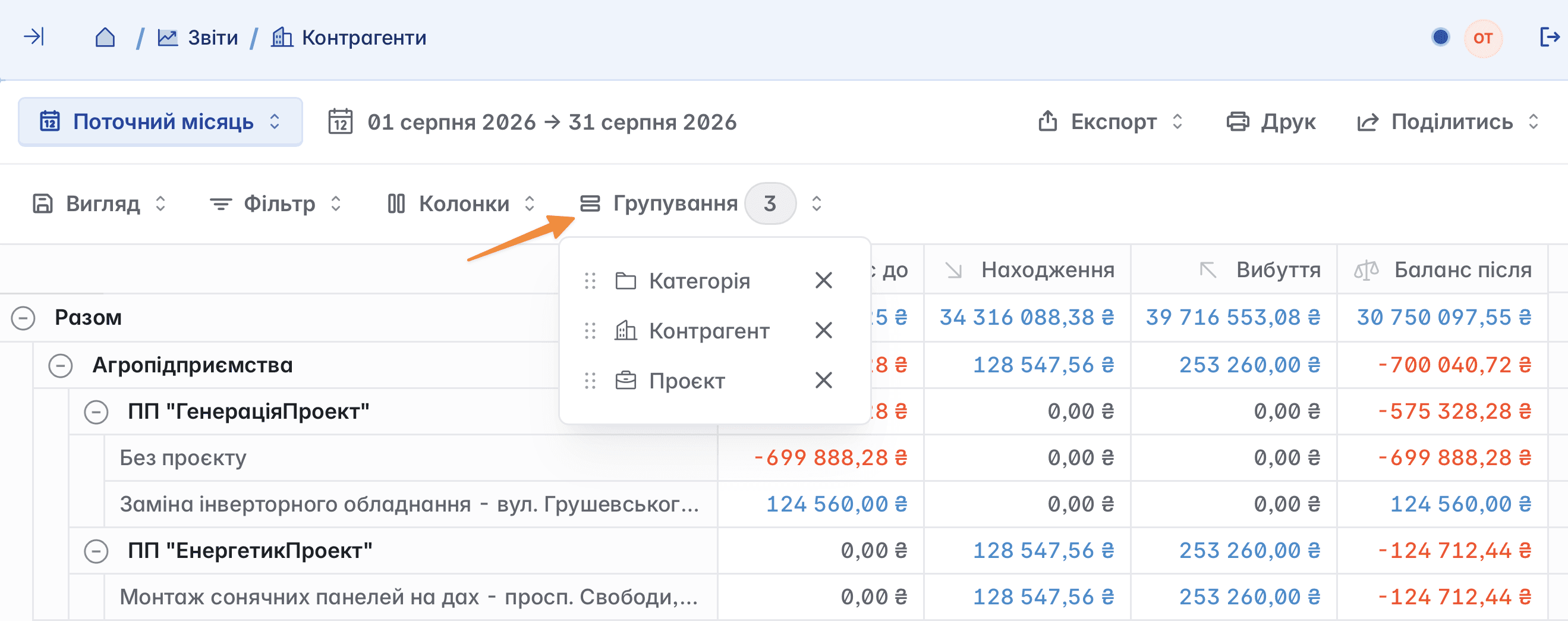
The faster a company sees where its money is, the faster it can react to payment issues.
Unnoticed expenses gradually reduce profit
Large expenses are usually noticed. But small regular payments can remain unnoticed. Delivery, procurement, additional materials, contractor services, transport costs - each individual amount may seem insignificant. But if expenses are not recorded systematically, it is difficult to understand how much the work of the company or a specific project actually costs.
In Keruj, expenses can be recorded in the financial module and used to analyze cash flow. This allows a transition from the question "How much did we earn?" to a more important question: "How much money do we have left after all expenses?"

Project profit can change during work
This is especially evident in the project business. At the beginning, a project may look profitable. There is an agreed amount, planned expenses, and an expected result. But during work, additional materials, services, transport costs, contractors' work, or other unforeseen expenses appear. If they are not taken into account, the final result will differ from the initial calculation.
Project economics in Keruj helps to see the financial picture of a specific project: its income, expenses, and result. Therefore, a manager can evaluate not only the general turnover of the company but also understand which projects bring in money and which reduce profit.

The warehouse is another place where money can be lost
Stock in the warehouse is frozen business money. If too much of it was purchased, funds remain in inventory for a long time. If there is not enough stock, the company may lose a sale because it will not be able to fulfill an order. Another problem is the mismatch between actual and system balances.
Keruj allows working with goods, balances, reserves, and expected arrivals. A manager can see up-to-date data while processing work with a client, even from a phone. This helps to make decisions based on available information rather than assumptions.

When one person's mistake becomes a company expense
Part of financial losses occurs due to the ordinary human factor.
An employee forgot to pass on information
Did not create a task
Did not update the status
Used old data
Did not see the message
It is impossible to completely eliminate human errors. But we can reduce their impact on business. For this, it is important that work information does not depend only on the memory of a specific employee.
In Keruj, tasks, documents, clients, projects, financial transactions, and other data can be linked to each other. This helps the team to work with a single set of information and not to lose important steps in the process.
What does a single system give a business?
When information is stored in one environment, it is easier to see the connection between operational work and financial results. These connections are important because money in business does not arise separately from processes. They are the result of the team's daily actions.
Therefore, to reduce losses, it is not enough to just look at the final report. You need to see exactly where in the process financial risks arise.
Keruj helps to see money in the context of work. Financial accounting on its own does not solve the problem of losses. It is important to understand where the money came from, where it went, and what operation it is connected to.
In Keruj, you can work with sales, procurement, warehouse, documents, projects, and finances in one system. This allows not just recording numbers but seeing them in the context of the company's daily work. And when information is available on time, it is easier to spot a problem before it turns into a financial loss.