Implementation

How internet infrastructure works and how it affects the operation of Keruj
Many users appreciate the continuous operation of online services. Especially when it comes to the operation of a business service like Keruj. But the Internet is not magic, but a set of technologies and companies interacting with each other. Sometimes temporary problems, known as service outages, occur in these chains.
What goes on "behind the scenes" of services?
Internet services are not just a single server or a single company. For a website or application to run fast, securely, and accessibly from different countries, many services rely on other large internet components, including:
content delivery networks (CDNs) - speed up access to web pages
DNS and proxy servers - route traffic
security services (firewall, anti-DDoS) - filter malicious traffic
monitoring and load balancing, etc.
One of these companies, without which the functioning of a part of internet traffic would be more difficult, is Cloudflare - a global network that serves approximately 1/5 of the world's total internet traffic.
Recent global outages of 2025
Recently, (18.11.2025) some internet services around the world became unavailable or worked with noticeable errors (HTTP 500/502/503 codes), as Cloudflare suffered major outages in its network. In technical blog posts and social media, people wrote that many popular sites were unavailable at the same time, and users recorded this en masse.
The reason lies in the internal logic of Cloudflare's operation and traffic routing. This was not a hacker attack, but a technical problem in handling high volume of traffic. Because of this, some traffic "hung" or went in the wrong directions, causing disruptions in access to a number of services and sites.
Another incident was recorded last week (05.12.2025). Official sources say that: Around 08:47 UTC (09:47 Kyiv time (UTC+2)), problems began, causing part of the network to stop processing traffic correctly.
About 25 minutes later, most of the services became stable again, but some users might have noticed delays or errors during this short incident.
This did not happen due to an attack, but because of an internal configuration change in an attempt to improve network security (to protect against certain vulnerabilities in web frameworks).
Due to these short-term discrepancies, some services using Cloudflare could temporarily show errors or take a long time to load, but overall internet stability was quickly restored.
And how did this affect Keruj users?
According to the status page of our service, Keruj did not have any recorded outages or unavailability over this period - all services were online and operational.
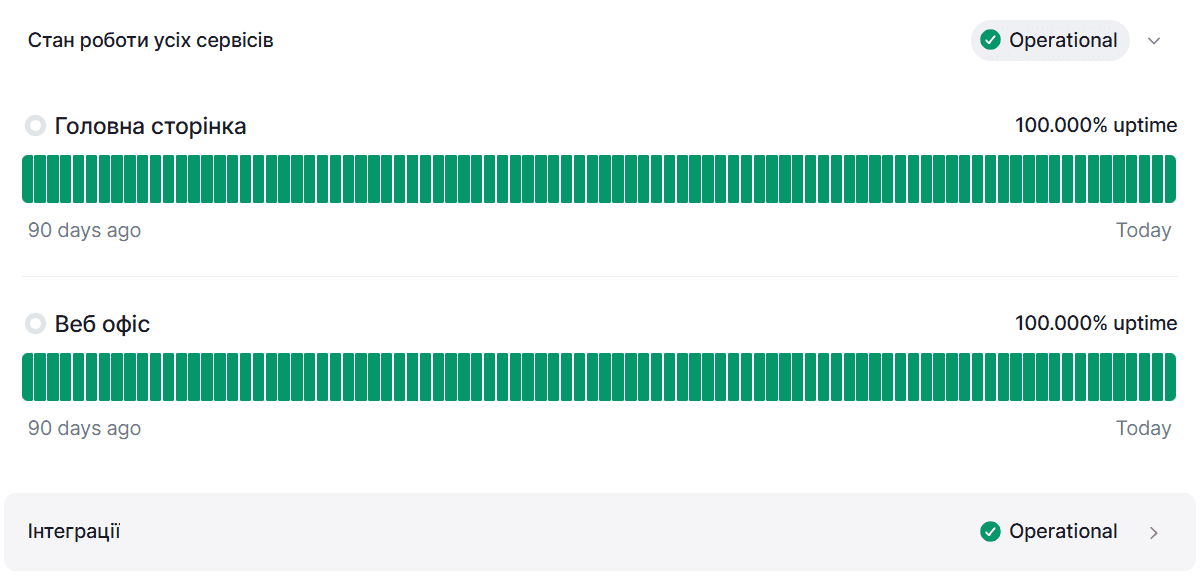
Why weren't we affected? Here are a few reasons:
Architecture and backup mechanisms
Keruj is built with the understanding that external services (such as CDNs, proxies, etc.) can be unstable. We use backup paths, caching, and load balancing, which allows us to:
minimize the impact of external problems;
ensure availability even during short-term problems with infrastructure partners.
Minimal dependency on external components in critical parts
Even if some traffic passes through external networks (like Cloudflare), critical operations of Keruj do not completely depend on a single provider. This reduces the risk that short-term outages will affect the business logic of the service.
Constant monitoring and alerting
We monitor the health of the service in real-time and have automatic alerting systems, allowing us to detect potential problems before they become noticeable to users.
Why internet service outages occur at all
Stability does not mean the complete absence of problems - it means the system's readiness to recover quickly from them.
Main reasons for temporary outages:
Maintenance and updates. Continuous security and infrastructure feature updates may require configuration changes or temporary traffic redistribution.
Local code or configuration bugs. Even in large companies, situations can occur where a change designed to improve performance leads to unforeseen consequences.
Unexpected load or peak traffic waves. Sharp spikes in the number of requests can overload the network or servers.
External factors. These can include provider network issues, equipment failures, power outages, etc.
Such events do not necessarily depend on us, but the job of the service is to reduce their impact on users.
Operational stability is not magic, it is architecture
A stable service is the result of:
smart architecture
backup mechanisms
thoughtful monitoring
preparedness for unforeseen circumstances
And even if an external infrastructure provider (like Cloudflare) suffers short-term outages, Keruj continues to work stably, ensuring availability and continuity for your tasks.


