Task

Control of deadlines without micromanagement: how it works in Keruj
Deadline control in most companies looks the same: the manager constantly has their finger on the pulse, writes to employees, clarifies statuses, and reminds them of tasks. From the outside, this looks like order, but inside, it is constant tension, lost time, and processes that depend on a single person.
The problem here is not the approach to management itself. The problem is that without a system, deadline control cannot be organized any other way. If tasks live in chats, deadlines are fixed "somewhere in the head", and responsible persons change without being reflected in the tools - micromanagement becomes the only way to keep everything under control.
Keruj changes the very principle of working with deadlines. Here, control does not require constant intervention because it is already embedded in the very logic of the processes.
The deadline as a part of the process, not a separate agreement
In Keruj, a deadline does not exist by itself. It is always tied to a specific task, and the task is tied to a broader context: a project, a client, or a document.
This is an important difference from the usual approach. In many companies, a deadline is just a date agreed upon in a chat or at a meeting. In Keruj, it is part of a structure that cannot get "lost."
When an employee opens a task, they immediately see not only the due date but also understand the process they are working within. This reduces the number of clarifications and allows for faster progress.
Transparency that replaces the question "What is the status?"
One of the biggest time-wasters in a manager's job is gathering information. You have to write, clarify, remind, and ask again. And so on every day.
In Keruj, the task status is updated directly during work. This is not a separate action "for the manager," but a natural part of the process. As soon as an employee moves a task forward, it is immediately reflected.
As a result, the manager opens the task list and sees the real picture: what is already being worked on, what is delayed, and what needs attention. Without messages, calls, and constant reminders.
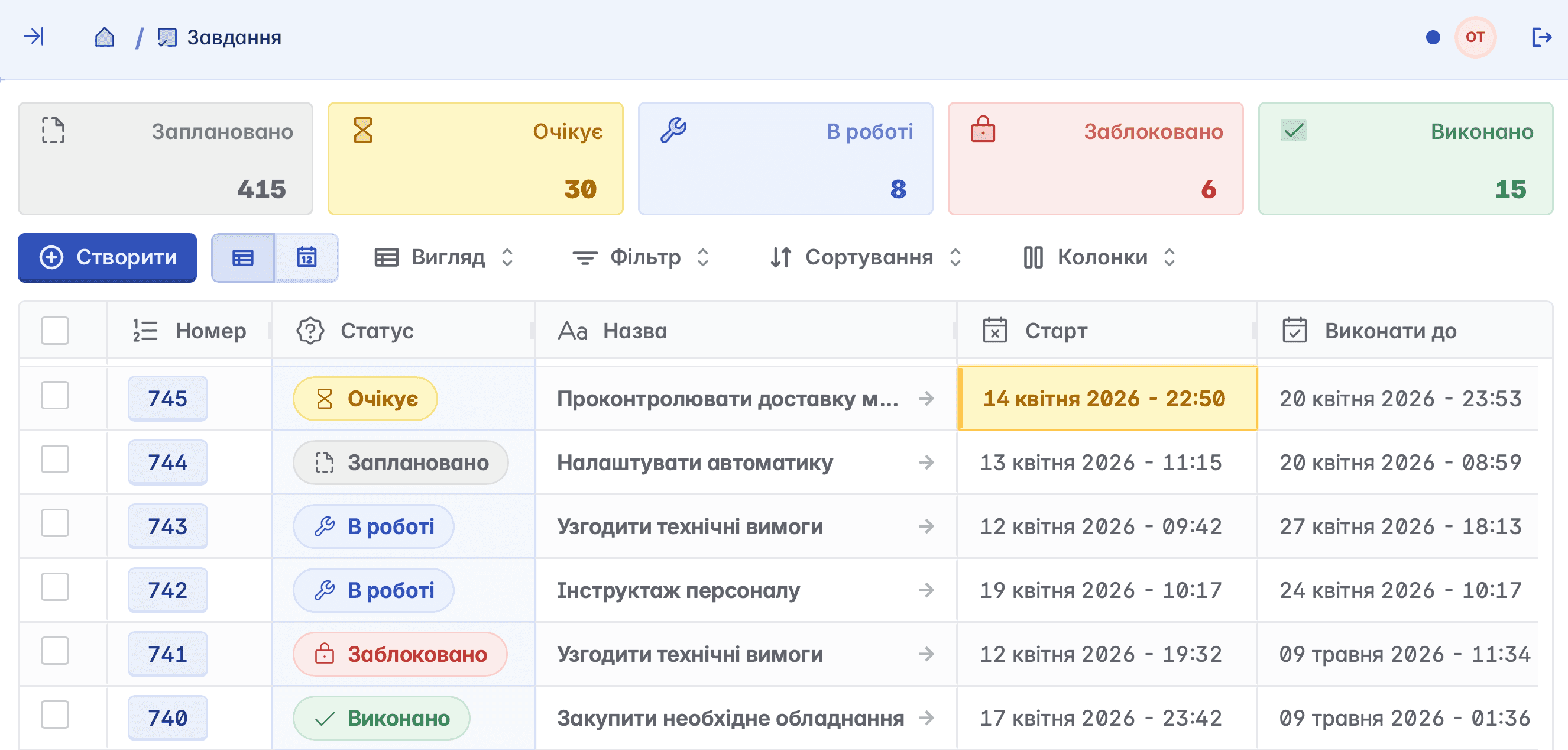
This is a fundamental change: control happens through data, not through communication.
Why tasks no longer get lost
One of the reasons for missed deadlines is not the complexity of tasks, but a simple loss of focus. When tasks are scattered across different channels, some of them simply fall out of sight.
In Keruj, all tasks are in a single environment. They are displayed in lists, linked to one another, and do not exist in isolation. If the responsible person or the stage of work changes, the task does not disappear and is not reset - it continues to live in the environment along with its deadline.
This creates a very simple but critically important thing: predictability. The team understands that no task will be lost, and the manager knows that all processes are under control even without constant checking.
The role of the manager is changing
When deadlines are controlled through the system, the role of the manager changes as well. They no longer need to be a "reminded-in-chief" or constantly keep everyone on their toes.
Instead, they work with deviations. If a task is delayed or a process goes wrong, it is visible immediately. And that is exactly the moment when intervention is needed.
This approach is much more effective. It allows you not to waste time on controlling what is already working and focus only on problem points.
Balance between freedom and responsibility
Control without micromanagement is always a balance. If you give complete freedom without transparency, processes will fall apart. If you control every step, the team will lose initiative.
Keruj allows you to find this balance. On the one hand, the employee clearly sees their tasks, deadlines, and priorities. On the other hand, the manager has access to up-to-date information at any moment.
This creates an environment where you don't need to "push" to get results. People work in a clear system where expectations are transparent and processes are logical.
What changes for business
When deadline control stops being a manual process, not only daily work changes but also the overall efficiency of the company.
Chaos in tasks disappears. The number of forgotten or postponed matters is reduced. The team starts working more independently, and the manager gains time for strategic decisions.
As a result, the business operates more stably. Not due to additional control, but thanks to properly designed processes.
Micromanagement is often perceived as a management style issue, but in reality, it is a consequence of lacking a system.
Keruj allows you to structure work in such a way that deadline control happens naturally - through the structure of tasks, transparency of processes, and interaction between modules.
And this is the main value: deadlines are met not because they are constantly being reminded of, but because they become an integral part of the work.


